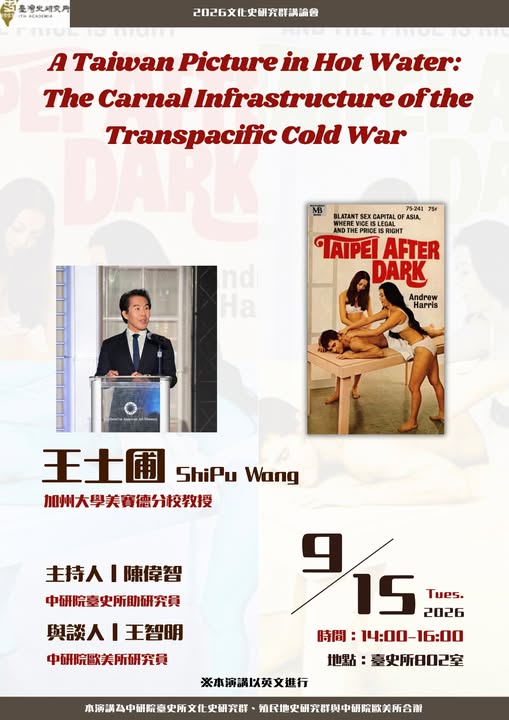
A Taiwan Picture in Hot Water: The Carnal Infrastructure of the Transpacific Cold Wa
|
||||||||||||||||
備註:
1.本次演講以英文進行。
2.本演講為中研院臺史所文化史研究群、殖民地史研究群與中研院歐美所合辦。
摘要:
Time’s 1967 Christmas issue ran a photograph of an American soldier bathing with two Taiwanese women at a Beitou (北投) hot spring, and the scandal it ignited exposes sex as a constitutive condition of Cold War geopolitics. Drawing on Republic of China (ROC) government and press archives, this talk reads the image as a window onto the carnal infrastructure of U.S.-led anti-communism: sexual labor and Asian female bodies as material resources for the American military’s Rest and Recuperation (R&R) network and alliance-building across Asia. Declassified records reveal a striking double game—sex tourism served as a covert instrument of the ROC’s geopolitical leverage, even as the government staged public outrage to disavow it once Time made it visible.
1.本次演講以英文進行。
2.本演講為中研院臺史所文化史研究群、殖民地史研究群與中研院歐美所合辦。
摘要:
Time’s 1967 Christmas issue ran a photograph of an American soldier bathing with two Taiwanese women at a Beitou (北投) hot spring, and the scandal it ignited exposes sex as a constitutive condition of Cold War geopolitics. Drawing on Republic of China (ROC) government and press archives, this talk reads the image as a window onto the carnal infrastructure of U.S.-led anti-communism: sexual labor and Asian female bodies as material resources for the American military’s Rest and Recuperation (R&R) network and alliance-building across Asia. Declassified records reveal a striking double game—sex tourism served as a covert instrument of the ROC’s geopolitical leverage, even as the government staged public outrage to disavow it once Time made it visible.