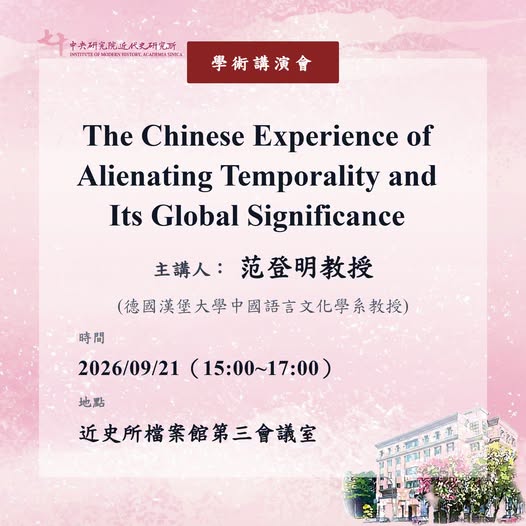
The Chinese Experience of Alienating Temporality and Its Global Significance
|
||||||||||||||
Abstract:
The dissemination of the linear-teleological conception of history, which assumed its modern form during the European Enlightenment, exerted a profound influence on Chinese views of modernity. Eurocentric entanglements arising from the introduction of the linear-teleological conception of history have been famously examined by postcolonial studies concerned with modern India. A Eurocentric problematic can also be identified in the case of China. Yet modern China differs in significant respects from the Indian case, such that a mere transposition of the findings of postcolonial studies would be inadequate. Both the emergence and the effects of the modern vision of historical temporality in China require further in-depth consideration in scholarship on modern China. Nor does the influential thesis of Eisenstadt, according to which so-called multiple modernities emerge in non-Western societies adequately account for the specific features of Chinese understandings of modernity. In order to delineate fundamental characteristics of Chinese modernity, a shift in perspective is therefore required—one that centers on the modern Chinese experience of an alienating temporality. This perspective has been envisaged by neither postcolonial studies nor the theory of multiple modernities nor previous research on Chinese responses to the West.
The dissemination of the linear-teleological conception of history, which assumed its modern form during the European Enlightenment, exerted a profound influence on Chinese views of modernity. Eurocentric entanglements arising from the introduction of the linear-teleological conception of history have been famously examined by postcolonial studies concerned with modern India. A Eurocentric problematic can also be identified in the case of China. Yet modern China differs in significant respects from the Indian case, such that a mere transposition of the findings of postcolonial studies would be inadequate. Both the emergence and the effects of the modern vision of historical temporality in China require further in-depth consideration in scholarship on modern China. Nor does the influential thesis of Eisenstadt, according to which so-called multiple modernities emerge in non-Western societies adequately account for the specific features of Chinese understandings of modernity. In order to delineate fundamental characteristics of Chinese modernity, a shift in perspective is therefore required—one that centers on the modern Chinese experience of an alienating temporality. This perspective has been envisaged by neither postcolonial studies nor the theory of multiple modernities nor previous research on Chinese responses to the West.