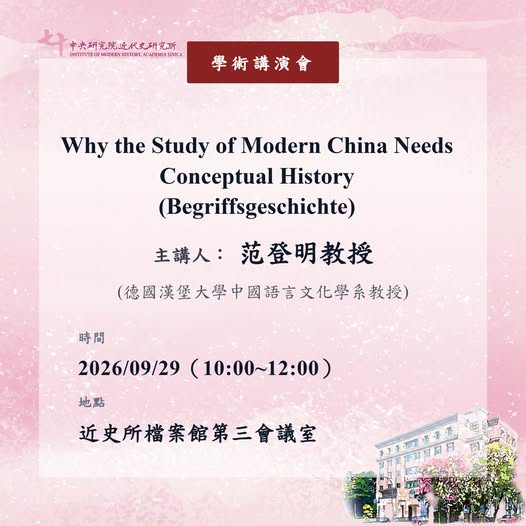
Why the Study of Modern China Needs Conceptual History (Begriffsgeschichte)
|
||||||||||||||
Abstract:
The formative phase of modern societies cannot be adequately understood without taking into account semantic shifts in the key concepts of political and social language. This observation applies with particular force to modern China, where linguistic change in the modern era assumed the form of a veritable disruption. It is well known that the massive influx of concepts of Western origin, which began in the late nineteenth century and continued into the first decades of the twentieth century, played a central role. Although this semantic transformation has received considerable attention in historical and philosophical scholarship on modern China, it has often remained the subject of separate, isolated studies devoted to particular concepts. Some studies in the field of historical semantics have addressed linguistic change as a whole, but without placing particular emphasis on transformations in the key concepts of political and social language. In this respect, the study of conceptual history developed in Germany and associated above all with the name of Reinhart Koselleck can provide important impulses for research on modern China. On this basis, the emergence and transformations of Chinese understandings of modernity as such can be delineated with greater precision and made fruitful for further research.
The formative phase of modern societies cannot be adequately understood without taking into account semantic shifts in the key concepts of political and social language. This observation applies with particular force to modern China, where linguistic change in the modern era assumed the form of a veritable disruption. It is well known that the massive influx of concepts of Western origin, which began in the late nineteenth century and continued into the first decades of the twentieth century, played a central role. Although this semantic transformation has received considerable attention in historical and philosophical scholarship on modern China, it has often remained the subject of separate, isolated studies devoted to particular concepts. Some studies in the field of historical semantics have addressed linguistic change as a whole, but without placing particular emphasis on transformations in the key concepts of political and social language. In this respect, the study of conceptual history developed in Germany and associated above all with the name of Reinhart Koselleck can provide important impulses for research on modern China. On this basis, the emergence and transformations of Chinese understandings of modernity as such can be delineated with greater precision and made fruitful for further research.