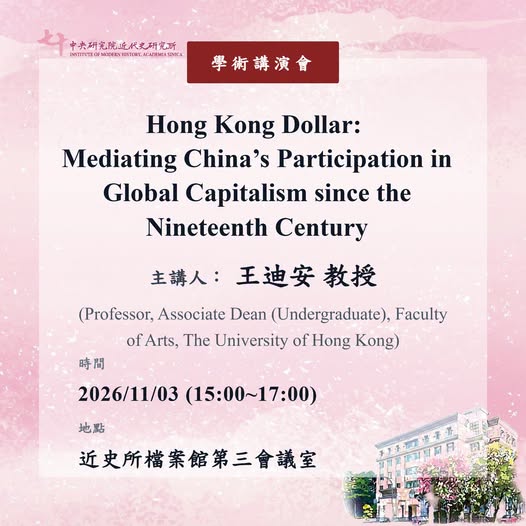
Hong Kong Dollar: Mediating China’s Participation in Global Capitalism since the Nineteenth Century
|
||||||||||||||
Abstract:
As a western foothold at the southern tip of China, Hong Kong has played a crucial role as China's interface with the world since the nineteenth century. Its relative attractiveness creates a gradient that induces the movement of people, goods, and capital, particularly within the neighboring region now known as the Greater Bay Area, as well as the rest of the Chinese Mainland. Understanding Hong Kong’s appeal requires considering broader regional and national contexts. Beyond the jurisdictional boundary separating Hong Kong from the Chinese Mainland, the city’s currency underscores its unique status while also linking China to the global economy. The Hong Kong dollar has served the city’s residents and regional operators as a medium for engaging with global capital markets. This talk explores the Hong Kong dollar, its circulation within the Greater Bay Area, and its role in connecting China to global capitalism.
As a western foothold at the southern tip of China, Hong Kong has played a crucial role as China's interface with the world since the nineteenth century. Its relative attractiveness creates a gradient that induces the movement of people, goods, and capital, particularly within the neighboring region now known as the Greater Bay Area, as well as the rest of the Chinese Mainland. Understanding Hong Kong’s appeal requires considering broader regional and national contexts. Beyond the jurisdictional boundary separating Hong Kong from the Chinese Mainland, the city’s currency underscores its unique status while also linking China to the global economy. The Hong Kong dollar has served the city’s residents and regional operators as a medium for engaging with global capital markets. This talk explores the Hong Kong dollar, its circulation within the Greater Bay Area, and its role in connecting China to global capitalism.