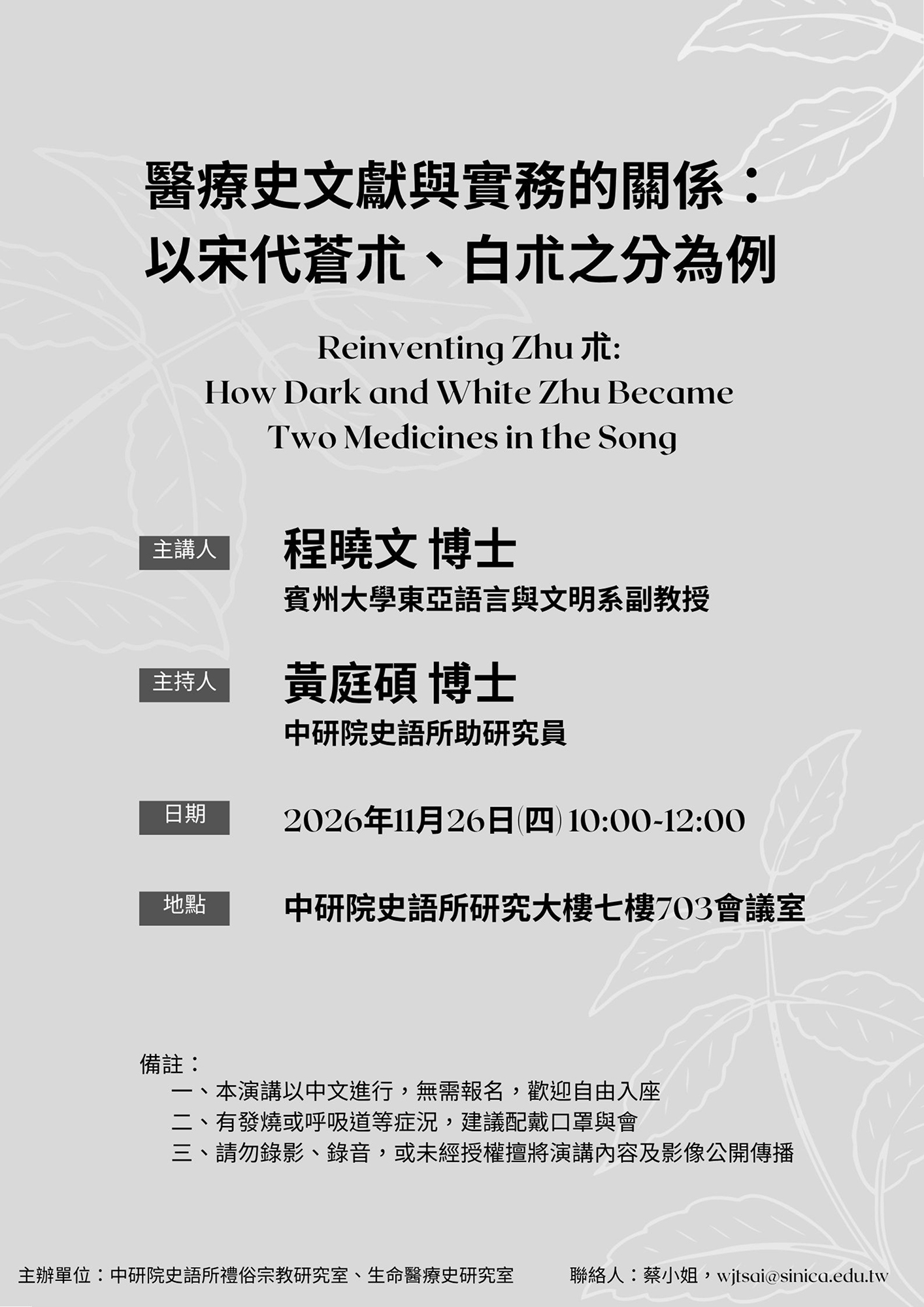
醫療史文獻與實務的關係:以宋代蒼朮、白朮之分為例
|
||||||||||||||
聯絡資訊: 蔡小姐,wjtsai@sinica.edu.tw
摘要
Zhu is the rhizome of a group of flowering plants indigenous to East Asia that belong to the Atractylodes genus. Today, Chinese medicine recognizes two kinds of zhu: cangzhu (dark zhu) and baizhu (white zhu). The two are not medicinally interchangeable, nor are they used together in one recipe. It is common knowledge that the sharp distinction between cangzhu and baizhu only emerged during the Song dynasty (960–1279). But why? What does the sudden emergence of such a sharp distinction in the late tenth century tell us about medical knowledge and practice during the Song dynasty? Song sources show that the meticulous effort of distinguishing baizhu and cangzhu was initially a textual one, carried out by government-commissioned editors. Nevertheless, the textual and historical investigation was deeply intertwined with concurrent practice on the ground. On the one hand, state-sponsored publications had the privilege of a near-monopoly over access to historical texts. On the other hand, however, a careful comparison of Song and pre-Song zhu recipes shows significant medical innovations in the usage of dark zhu in the eleventh and twelfth centuries. A micro-history of zhu, and especially of dark zhu, presents a unique window into the relationship between medical texts and practice in mid-imperial China and the significance of medicinal materiality.