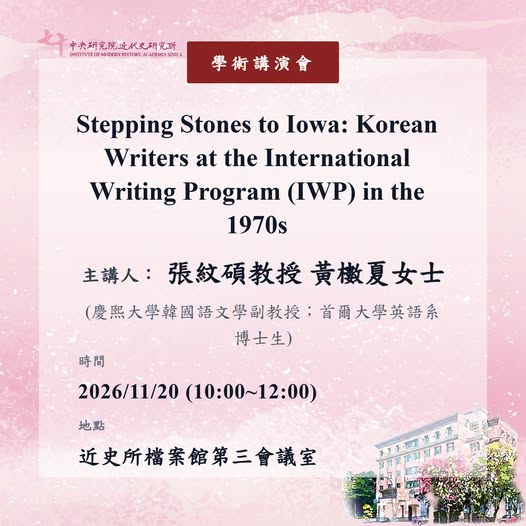
Stepping Stones to Iowa: Korean Writers at the International Writing Program (IWP) in the 1970s
|
||||||||||||||
演講簡介:
Overseas travel remained out of reach for most Korean writers in the 1970s. Only a few, often those able to fund their own trips, could travel abroad. When Paul Engle and Hualing Nieh invited Korean writers to the University of Iowa’s International Writing Program (IWP) in 1970, they offered a rare opportunity to encounter the world. This talk explores the conditions under which Korean writers were able to experience Iowa during the Cold War and what this encounter meant for their literary practice.
Drawing on the IWP archives at the University of Iowa Libraries, the talk focuses on four Korean participants of the 1970s whose archival records are relatively extensive: Hwang Dong Kyu, Choe In-Hoon, Joung Hyun Jong and Kim Yoon-shik. It traces how they were selected and how their travel expenses were funded. Korean participants were generally nominated either by scholars of English literature who had studied in the U.S. or by Korean IWP alumni. In the early 1970s, the lack of an established working relationship with the U.S. Embassy made funding difficult to secure. Each year brought different circumstances, and the IWP worked with Korean writers to negotiate with multiple stakeholders, including the U.S. Embassy in Seoul, the State Department, and the Korean-American Educational Commission, reconciling their interests to enable Korean participation.
The talk also examines the writers’ activities in Iowa, such as a required seminar on Korean literature and co-translation, as well as the accounts of their Iowa experience that they published after returning home. Korean participants showed particular interest in engaging with writers from the Eastern Bloc. Although shaped by the cultural Cold War, the IWP gave Korean writers a rare opportunity to reach beyond the Korean Peninsula and engage with writers around the world.