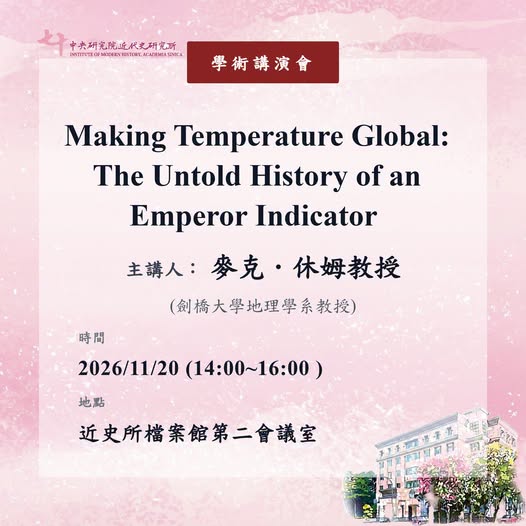
Making Temperature Global: The Untold History of an Emperor Indicator
|
||||||||||||||
Abstract:
Numbers shape the world around us in powerful ways. Global temperature is one such number which, over the past 30 years, has become central for guiding and evaluating international climate policy. From the Paris Agreement—with its aim to limit global warming to between 1.5 and 2°C above the 19th century level—to the concept of Net Zero, global temperature shapes global politics and our visions for the future. It has become an ‘emperor indicator’. But what is global temperature? Was it discovered or invented, and when? How did scientists come to place such importance on this one number? Based on a forthcoming book, this talk introduces the history of this hugely consequential number which has hitherto remained untold. The story starts in the 1870s and culminates in the early 1980s when two independent efforts, on either side of the Atlantic, resulted in this index of global climate first gaining scientific credibility and, more importantly, political salience. Understanding this history helps us see more clearly the merits and demerits of using global temperature to guide policy. But might there have been, and might there still be, better ways of measuring the health of the world’s climate?
Numbers shape the world around us in powerful ways. Global temperature is one such number which, over the past 30 years, has become central for guiding and evaluating international climate policy. From the Paris Agreement—with its aim to limit global warming to between 1.5 and 2°C above the 19th century level—to the concept of Net Zero, global temperature shapes global politics and our visions for the future. It has become an ‘emperor indicator’. But what is global temperature? Was it discovered or invented, and when? How did scientists come to place such importance on this one number? Based on a forthcoming book, this talk introduces the history of this hugely consequential number which has hitherto remained untold. The story starts in the 1870s and culminates in the early 1980s when two independent efforts, on either side of the Atlantic, resulted in this index of global climate first gaining scientific credibility and, more importantly, political salience. Understanding this history helps us see more clearly the merits and demerits of using global temperature to guide policy. But might there have been, and might there still be, better ways of measuring the health of the world’s climate?