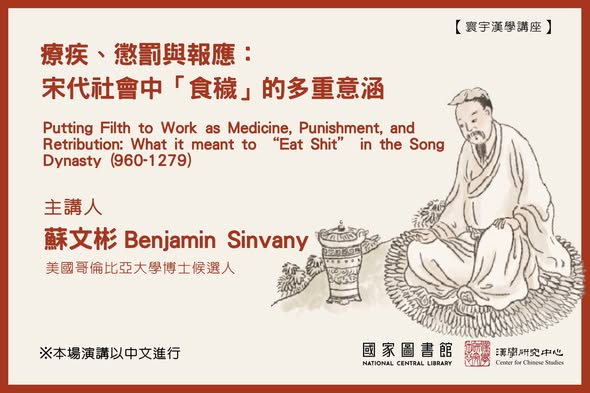
療疾、懲罰與報應:宋代社會中「食穢」的多重意涵(Putting Filth to Work as Medicine, Punishment, and Retribution: What it meant to “Eat Shit” in the Song Dynasty (960-1279))
|
||||||||||||||
備註:本場演講以中文進行
更多講座相關資訊請至:
https://actio.ncl.edu.tw/activitydetails?uid=2&pid=933
演講摘要:
This talk is about the consumption of filth in the Song dynasty. Sometimes referred to as “eating shit” (食糞) or “eating filth” (食穢) this talk presents accounts of people literally eating feces. It uses a wide selection of Song sources including biji, records of the strange 志怪, medical prescription texts, as well as historical anecdotes preserved in leishu 類書. Taken together, these excerpts form a diverse mosaic of extreme behaviors. In some cases, people demand to eat feces, in others they are forced to consume it against their will, and in others it is administered as a known antidote to poisoning. There appear to be at least three different reasons people consumed human excrement in Song China: coercion, divine retribution, and medicine. The cases presented here reveal a logic of purity in the Song that allowed eating filth to function as a method for healing (an antidote to poison), a coercive punishment, and a symptom of divine retribution.
主講人簡介:
Benjamin is a History-East Asia Ph.D. candidate at Columbia University researching the social history of Song (960-1279) China. Broadly defined, his interests include technology, knowledge transmission, and social constructions of waste and disgust. Benjamin uses non-traditional sources like collections of ghost tales and other strange stories alongside technical manuals to investigate historical social change. In earlier work, Benjamin argues that access to key resources like nitrogen salts (saltpeter) and sulfur by multiple states in twelfth- and thirteenth-century East Asia was a primary driver of the invention of explosives (e.g., gunpowder). His current dissertation project, tentatively titled “Putting Waste to Work: Feces and Knowledge in Song (960-1279) China” broadens traditional comparative questions in the history of science (e.g., was saltpeter was made from human and animal excrement and urine in East Asia as it was in Europe?) to historicize human feces as something both useful and repugnant, powerful and dangerous. Documenting the uses and views of human feces in China from 900-1300 AD – a moment of unprecedented population growth, and abundance of new technologies, and a highly commodified society – provides a unique perspective on the accumulation and transmission of practical knowledge about the natural world. Benajmin’s dissertation project reflects his interest in mobilizing social and cultural historical methods to answer questions at the intersection of Chinese studies and histories of knowledge.
Before arriving at Columbia, Benjamin completed a BA at Emory University (Atlanta, '15) and an MA (International Studies) at Johns Hopkins University and Nanjing University (Nanjing, '20). He was born in Columbus, Ohio. He regularly joins Contact Improvisation workshops and jams. Occasionally, he competes in Waterski and Wakeboard competitions.
更多講座相關資訊請至:
https://actio.ncl.edu.tw/activitydetails?uid=2&pid=933
演講摘要:
This talk is about the consumption of filth in the Song dynasty. Sometimes referred to as “eating shit” (食糞) or “eating filth” (食穢) this talk presents accounts of people literally eating feces. It uses a wide selection of Song sources including biji, records of the strange 志怪, medical prescription texts, as well as historical anecdotes preserved in leishu 類書. Taken together, these excerpts form a diverse mosaic of extreme behaviors. In some cases, people demand to eat feces, in others they are forced to consume it against their will, and in others it is administered as a known antidote to poisoning. There appear to be at least three different reasons people consumed human excrement in Song China: coercion, divine retribution, and medicine. The cases presented here reveal a logic of purity in the Song that allowed eating filth to function as a method for healing (an antidote to poison), a coercive punishment, and a symptom of divine retribution.
主講人簡介:
Benjamin is a History-East Asia Ph.D. candidate at Columbia University researching the social history of Song (960-1279) China. Broadly defined, his interests include technology, knowledge transmission, and social constructions of waste and disgust. Benjamin uses non-traditional sources like collections of ghost tales and other strange stories alongside technical manuals to investigate historical social change. In earlier work, Benjamin argues that access to key resources like nitrogen salts (saltpeter) and sulfur by multiple states in twelfth- and thirteenth-century East Asia was a primary driver of the invention of explosives (e.g., gunpowder). His current dissertation project, tentatively titled “Putting Waste to Work: Feces and Knowledge in Song (960-1279) China” broadens traditional comparative questions in the history of science (e.g., was saltpeter was made from human and animal excrement and urine in East Asia as it was in Europe?) to historicize human feces as something both useful and repugnant, powerful and dangerous. Documenting the uses and views of human feces in China from 900-1300 AD – a moment of unprecedented population growth, and abundance of new technologies, and a highly commodified society – provides a unique perspective on the accumulation and transmission of practical knowledge about the natural world. Benajmin’s dissertation project reflects his interest in mobilizing social and cultural historical methods to answer questions at the intersection of Chinese studies and histories of knowledge.
Before arriving at Columbia, Benjamin completed a BA at Emory University (Atlanta, '15) and an MA (International Studies) at Johns Hopkins University and Nanjing University (Nanjing, '20). He was born in Columbus, Ohio. He regularly joins Contact Improvisation workshops and jams. Occasionally, he competes in Waterski and Wakeboard competitions.